


In June 2021, the G7 Summit came to Carbis Bay. World leaders from seven nations, their delegations, thousands of journalists, and what felt like half the world’s security services descended on a quiet stretch of the Cornish coast.
For a few extraordinary days, Cornwall was the centre of everything.
In the weeks leading up to it, we were commissioned by the Cornwall and Isles of Scilly Local Enterprise Partnership to create a series of films. The brief was clear: the world’s press was about to arrive, and Cornwall had a bigger story to tell than beaches and cream teas.
The LEP wanted to showcase Cornwall’s emerging economic sectors: geo-resources, clean energy, data and space, digital and tech. Five films, each telling a different part of Cornwall’s future. Plus a 45-minute journalist briefing hosted by LEP Chief Executive Glenn Caplin-Grey, designed to go directly to the international media covering the summit.
Cornwall already generated 40% of its power from renewables and was targeting net zero carbon by 2030, twenty years ahead of the rest of the UK. The G7 was Cornwall’s chance to put that story in front of the world.
The communications strategy behind the campaign was developed by Katie Sandow at Studio Sandow, who shaped the brief, identified the businesses and people we needed to speak to, and coordinated the wider media effort. Katie’s work behind the scenes was a big part of why this project came together so well. We worked closely with her throughout, and what followed was one of the most memorable commissions we’ve had.
Going Underground
Of all the places the project took us, South Crofty is the one that stays with you.
The mine sits between Camborne and Redruth, and mining activity there has been recorded as far back as 1592. That’s the reign of Elizabeth I. When you go underground and see the tunnels stretching away into the dark, you’re looking at something that connects four centuries of Cornish working life. At its peak, South Crofty extended nearly two and a half miles across and 3,000 feet down. The whole local economy once ran on what was pulled out of these shafts.
It closed in 1998, the last working tin mine in Europe. But the story isn’t over. The team at Cornish Metals, who now own the mine, described tin as the forgotten foot soldier of the high-tech world: it’s in your phone, your laptop, robotics, power generation, energy storage. South Crofty’s ore is high grade enough to make mining it worthwhile again.
The mine was just one part of the geo-resources story. We also visited British Lithium and Cornish Lithium to understand the different approaches being taken to unlock Cornwall’s lithium deposits. British Lithium had been the first to explore for lithium in Cornwall back in 2018, drilling over 100 million tonnes of lithium mica granite and developing their own carbon-free processing technology to produce battery-grade lithium carbonate: enough to supply a third of the UK’s requirements if the country switched to electric vehicles. Cornish Lithium were taking a dual approach, extracting from hard rock granite and from geothermal waters. Two methods, same mineral, same county.
Together, they painted a picture of an entire sector coming to life. We ended up returning to South Crofty after this project and made a short documentary about Cornish mining. That’s a story for another post.
From Underground to Outer Space
If South Crofty took us back four hundred years, the next part of the project pointed straight at the future.
Spaceport Cornwall at Newquay Airport was positioning itself to become one of the UK’s first operational spaceports for horizontal launch. The concept was extraordinary: a modified 747 carrying a 70-foot rocket under one wing, using the existing airport runway to get satellites into lower Earth orbit. They were already planning a satellite integration facility alongside the spaceport, building the infrastructure for an entire space cluster in Cornwall.
We also filmed with Flylogix, who were using drones to deliver medical cargo between the Isles of Scilly and the mainland, the first service of its kind in the UK. Time-sensitive equipment, medicines, blood samples, all carried by drone to cut carbon emissions and improve response times for island communities.
Then there was Goonhilly Earth Station on the Lizard Peninsula. If you’ve driven past it, you’ll know the dishes. What you might not know is that Goonhilly had been revamped for the new space era since being acquired in 2014, and its ambitions go far beyond satellite monitoring. The team told us about their involvement in upcoming lunar missions, using the moon as a stepping stone to Mars, and plans to expand globally with offices and antennas around the world. All coordinated from a hillside in west Cornwall.
In the span of a few days, we went from tunnels dating back to the 1590s to a satellite station preparing for missions to the moon. That’s Cornwall in a single commission.
Clean Energy and Digital Cornwall
The remaining two films rounded out the picture.
Cornwall’s geography makes it a natural fit for clean energy, and the specifics were genuinely impressive. Eden Geothermal had drilled to 5.2 kilometres, bringing water to the surface at around 180 degrees Celsius: enough electricity for around 7,000 homes and enough to make the entire Eden Project better than carbon neutral. Out at sea, Cornwall is one of only two locations in the UK with the right water depth for floating offshore wind, with an ambition of three gigawatts installed by 2030. We also filmed with Bennamann, who were capturing waste methane and converting it to vehicle fuel, achieving a negative carbon footprint in the process.
On the digital and tech side, we spent time at Falmouth University’s Games Academy and with Launchpad, the only venture studio in the UK embedded within a world-class creative university. Data Duopoly, one of their startups, had built a gamified interactive map for the Eden Project using GPS and satellite technology, managing to shift a third of visitor traffic on site through personalised offers. We also filmed Future Farm at Duchy College, tackling agricultural emissions monitoring in a region where 20% of the carbon footprint is linked to farming. The breadth of what’s happening in Cornwall’s tech sector doesn’t always get the recognition it deserves.
The Week Itself
The sector films were all shot in the run-up to the summit. By the time the G7 started on 11 June, the journalist briefing was already circulating internationally with journalists from France, Germany, and Japan watching alongside UK national media.
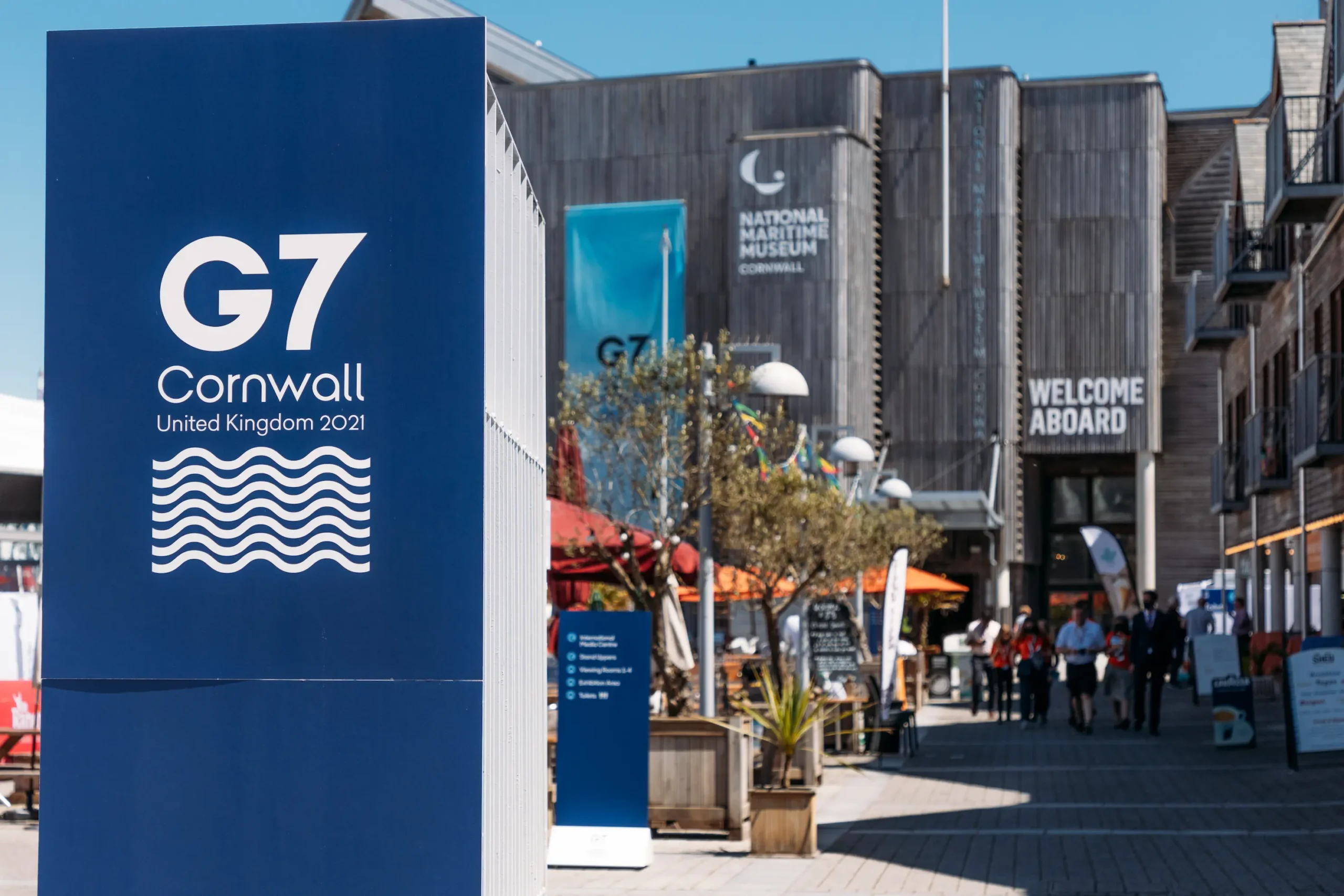
On the week of the event itself, we were based in Falmouth, where the International Media Centre had been set up. Events Square and the National Maritime Museum Cornwall had been transformed into a security island. Fencing, checkpoints, credentials, police everywhere. The museum had become a full event hub with briefing rooms for press conferences, working spaces for international broadcasters, government announcement facilities. Walking through a building we’d visited countless times, now full of journalists from every corner of the world with satellite trucks lining the streets outside, felt genuinely surreal.
We had access to document the event for both the museum and the LEP. But the thing that really hit you was the life it brought to the area. After a stretch of lockdowns and quiet winters, Cornwall was suddenly vibrating with energy. Politicians, protesters, activists, press, business leaders, world leaders, police. Every restaurant was full. Every street had something happening. Whatever your politics, the sheer scale of global attention focused on this small corner of the UK was something to witness.


What It Meant
Looking back, this was one of those commissions that reminds you why you do this work. We got to tour the very best of what Cornwall has to offer. Not the postcard version, but the real story: 400-year-old mine tunnels with a billion-pound future, a satellite station on the Lizard preparing for lunar missions, geothermal wells tapping into the earth’s heat, a generation of tech talent building businesses in a place most people only associate with holidays.
We made five films and a journalist briefing that put all of it in front of the world’s media at a moment when the whole planet was watching. We’re glad we got to help tell a chapter of Cornwall’s story.
Update: The Cornwall and Isles of Scilly LEP has since been wound down, with its functions transferring to Cornwall Council in 2024. But the sectors it championed are still growing. South Crofty is still working toward reopening. The clean energy targets are more urgent than ever. Cornwall’s story keeps moving forward.


