


In early 2021, the world was still running slower than usual. Productions had paused, travel was restricted, and the way television got made had quietly shifted. Networks that would normally send crews from London or Manchester started looking closer to the ground: local teams already based in the places they wanted to feature.
That’s how History Hit found us. They came across PixelRain through our website, liked what they saw, and got in touch about producing a new documentary series set in Cornwall. The concept was called Forgotten Cornwall: two 25-minute episodes exploring stories from the county’s past, presented by chef and broadcaster James Strawbridge.
For us, it was a different kind of project. We’d built PixelRain around commercial content for lifestyle and leisure brands: food films, destination pieces, property work. Documentary was something we’d always been drawn to but hadn’t had the opportunity to do at this scale. When History Hit said they loved our style and wanted to collaborate, we didn’t need asking twice.
Building two episodes from scratch
The series needed to feel authentic to Cornwall, not a surface-level tour but something with real depth. That meant months of research before we picked up a camera. We combined our own local knowledge of places and people with proper historical digging: reading archives, tracking down experts, mapping out narratives that could carry a full episode each.
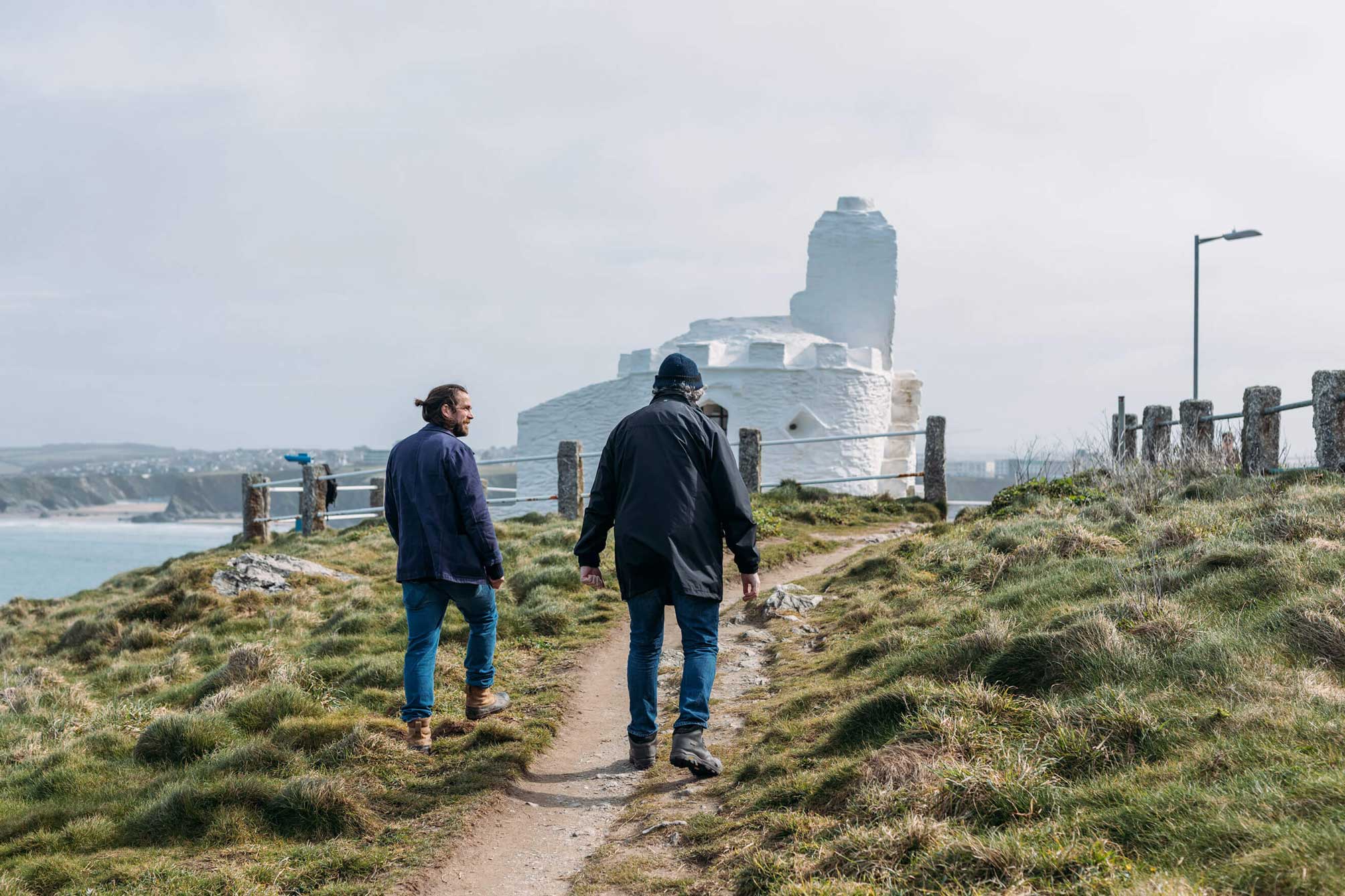
Episode one focused on the pilchard industry: the Huer’s Hut in Newquay, the fishing heritage of Mousehole and Newlyn, and the story of how a humble fish shaped an entire coastal economy. Episode two took on Cornish mining: the Tin Coast, Levant Mine, Botallack, and the still-operational South Crofty.
History Hit worked with us throughout, giving light steering on editorial direction to make sure our episodes didn’t overlap with other programming on the platform. We tweaked the style together until everyone was happy with how it felt. But the research, the local contacts, the shape of each story: that came from us.
The people who made it real
The best part of documentary work is the people you meet. For the pilchard episode, we connected with Leonard Sheppard, a local historian and Chairman of the Newquay Old Cornwall Society. Len came to us with an incredible wealth of knowledge about the Huer’s Hut: stories, artefacts, photographs. The kind of detail you can’t find in a textbook. His passion for the subject was infectious, and it set the tone for the whole episode.
At Newlyn Harbour, Andrew Lakeman from Ocean Fish walked us through the port’s history and how the sardine industry operates today. We spoke with boat skippers about modern fishing techniques, drawing a line from the old Huer lookouts to present-day sonar systems. At Stevenson’s fish shop, Elaine Lorys gave James the kind of warm, conversational exchange that makes documentary feel human rather than scripted.
For the mining episode, James Breslin from the National Trust guided us through Levant Mine’s extraordinary history, and Owen from Cornish Metals gave us access to South Crofty that we couldn’t have imagined. Every person we filmed brought something that lifted the series beyond what we could have achieved alone.
Filming a Cornwall nobody else got to see
There was something strange and beautiful about filming in Cornwall during that period. The world wasn’t fully back to its normal self yet. Many of the shoots we did were incredibly quiet, and we often had locations entirely to ourselves.
The Huer’s Hut with nobody around. Mousehole harbour in near silence. The clifftop paths along the Tin Coast without another soul in sight. As filmmakers, it was a gift. These are places that are usually busy with visitors, and rightly so. But for a few months in 2021, we got to capture them in a way that probably won’t happen again. The light, the stillness, the sense of having Cornwall to ourselves: it gave the series a quality we couldn’t have planned for.


Going underground at South Crofty
The South Crofty sequence in episode two has a backstory of its own. Earlier that year, we’d been producing films for CIOS LEP covering the G7 Summit in Cornwall, which included a shoot at South Crofty. That’s where we met Owen from Cornish Metals. After we’d wrapped our shoot for that project, Owen offered to take us into a deeper, older part of the mine. We were already in early conversations about the Forgotten Cornwall documentary at that point, and the moment we stepped underground, we knew we had to come back with James.
And what an experience it was. For me and Grant, who had never been in an environment like that before, it was almost overwhelming. The darkness was total. The silence was eerie in a way that’s hard to describe: not just quiet, but the complete absence of the world above. Another world entirely.
As we walked through, the tunnels shifted constantly. Sections so tight you had to watch your step, then all of a sudden the roof would lift up as far as the torchlight could reach. Huge cavernous areas that had been entirely mined out over centuries. Gone. You felt small standing in them, knowing that everything above you: the towns, the roads, everyday life, was carrying on just 40 or 50 metres overhead.
Old carts and metal tools sat where they’d been left, well preserved. Like time had frozen. And this was just the upper levels. South Crofty goes deep: workings reaching almost 900 metres at its peak, spanning nearly 4.5 kilometres across. The jewel in the crown of Cornish mining history, and the last working tin mine in Europe before it closed in 1998.
When we returned with James and the full kit to film the episode, that first-hand experience shaped everything. We knew which tunnels had the most atmosphere, where the light fell in interesting ways, which moments would land on screen. It’s the kind of preparation that doesn’t show up in a production schedule but makes all the difference to the final film.


Levant Mine and the weight of history
Levant sits high on the clifftops of the Tin Coast, preserved by the National Trust and home to the world’s last operational Cornish beam engine powered by steam. It’s a place where history isn’t kept behind glass. The volunteers who run the old equipment were incredibly knowledgeable, and you could tell they genuinely cared for the site and what it represents.
Levant was known as the queen of Cornwall’s submarine mines, with workings stretching more than a mile beneath the sea. But it’s best known for something far more sobering. In 1919, the man-engine broke: a set of moving platforms that miners stepped on and off to travel up and down the shafts. Thirty-one miners lost their lives. Hearing that story for the first time in person, standing on the site where it happened, really makes you stop. It’s humbling in a way that changes how you approach the rest of the day’s filming.
One moment that particularly stuck with us was lining up a shot we’d found from a very old photograph, taken during the mine’s most active days, and cutting to our own shot of the same view today. The landscape has changed, but the bones of the place are still there. That kind of visual storytelling: past and present held together in a single edit: is what documentary does at its best.
James Strawbridge: secret historian, secret weapon
James brought a brilliant energy to the series. He’s known as a chef and food expert, but what came across immediately on set was that he’s a genuine history enthusiast. He’d dig into the research material, ask follow-up questions the crew hadn’t thought of, and draw out stories from interviewees with a warmth that put people at ease.
That combination worked perfectly for Forgotten Cornwall. The pilchard episode ends with James cooking sardines on a beach fire at Palace Cove, tying the history of the industry back to the food itself. The mining episode closes with him making a Cornish pasty: the miners’ staple, carried underground in cloth bags, the crimped crust doubling as a handle for hands that might be covered in arsenic dust. In both cases, the food wasn’t a gimmick. It was the thread that connected centuries of history to something tangible and human.
He’s also great company on a shoot, which helps when you’re spending long days on clifftops and down mines together.
A different kind of filmmaking
Producing Forgotten Cornwall was a completely different approach to our commercial work. Documentary is slower, more considered, more traditional. You’re not trying to capture a brand’s essence in 60 seconds. You’re building a narrative across 25 minutes, layering archive material with interviews, pieces to camera, and footage that needs to carry emotional weight.
We loved it. The pace suited us. The depth of research, the time spent with people and places, the editorial decisions about what stays and what goes: it all felt like a natural extension of the storytelling instinct that drives everything we do. Commercial work is about distillation: finding the sharpest version of a message. Documentary is about immersion. Both require craft, but they use it differently.
It also confirmed something we’d suspected for a while: long-form content is where some of our best work happens. The kind of storytelling that takes its time, respects the subject, and trusts the audience to come along for the journey.
Watch the series
Both episodes of Forgotten Cornwall are available to stream on History Hit. Episode one covers the rise and fall of Cornwall’s pilchard industry, from the Huer’s Hut in Newquay to the fishing heritage of Mousehole and Newlyn. Episode two follows the Tin Coast from Levant Mine to Botallack and deep underground at South Crofty, uncovering a mining story that stretches back to the Bronze Age.


