


Between 2021 and 2022, we travelled the length of Cornwall documenting a set of projects that, taken together, tell the story of where the county was heading.
Spaceports, lithium pilot plants, a revived theatre in the heart of Truro, a new STEM centre, a dairy expansion, and a geothermal pilot plant. All of them funded by the government’s Getting Building Fund. All of them coordinated by the Cornwall and Isles of Scilly Local Enterprise Partnership.
It feels like the right moment to look back at this work. The LEP has since been wound down, with its functions transferring to Cornwall Council in 2024. But the investments it championed are still shaping the region, and we’re glad to have been there to capture them as they broke ground.
The Fund and the Brief
In 2020, the UK government announced £900 million of Getting Building Fund investment, designed to support jobs, skills, and infrastructure in parts of the country facing significant economic pressure from the pandemic. Cornwall and the Isles of Scilly received a substantial share, distributed through the LEP across a set of projects chosen for their ability to accelerate the region’s economic recovery and its longer-term transition toward clean growth, creative industries, and high-tech manufacturing.
Our brief was to document the projects as they progressed. Some were early in the ground. Others were well underway. The goal was a set of films that showed where the money was going and, just as importantly, what it was building toward.
The Projects
Hall for Cornwall, Truro
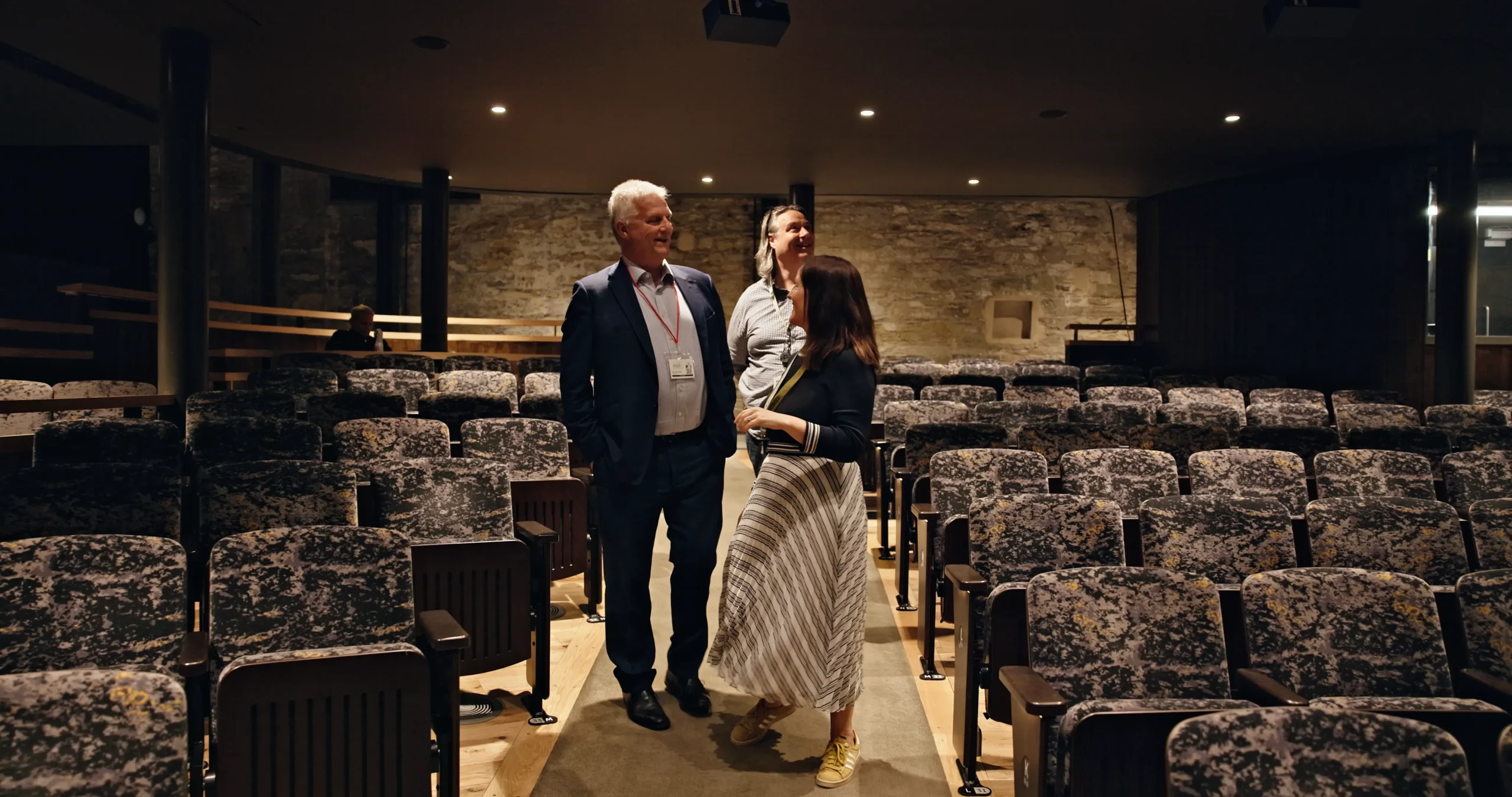
The Hall for Cornwall investment was one of the most visible uses of the fund. A purpose-built, accessible theatre with 1,300 seats, destination bars and cafes, and new workspace for the creative industries in the centre of Truro. Filming inside while the fit-out was still underway, you could already see what it would become. The scale of the auditorium, the acoustics of the empty space, the way the redevelopment had quietly transformed a building the city had known for generations.
The ambition was to grow audiences to over 300,000 a year and drive meaningful footfall back to Truro’s high street at a moment when town centres across the country were trying to work out what came next. That part of the story felt as important as the theatre itself.
Truro and Penwith College
Truro and Penwith College received capital investment to develop a specialist STEM Skills Centre on land adjacent to the Callywith Campus. The centre would deliver industry-relevant provision in health sciences, digital, engineering, and manufacturing, from Level 2 through to Level 5, including T-Levels.
What made the project distinctive was its location. North and East Cornwall had long been what the LEP described as a ‘cold spot’ for educational infrastructure. The Skills Centre wasn’t just about new classrooms. It was about making sure young people in that part of the county had access to the kinds of courses that typically clustered further west.
Spaceport Cornwall
A £2 million investment went into Spaceport Cornwall at Newquay, supporting construction of new facilities including a satellite integration facility. This was where satellites would be loaded into rockets ahead of horizontal launch: a modified 747 carrying a rocket under one wing, using the existing airport runway to get payloads into low Earth orbit.
Filming at Newquay during this period, the scale of what was being built genuinely took us by surprise. Alongside the integration facility, plans were already in motion for an operations centre and a clean room laboratory aimed at space-related companies setting up in the region. The ambition wasn’t a single launch. It was an entire cluster.
Saputo Dairy UK
Further up the county, the Saputo Dairy investment took us somewhere very different. The funding was earmarked for supporting infrastructure that would let the plant increase cheese and whey production.
The requirement was that the growth had to be sustainable. The infrastructure had to drive capacity while also improving environmental compliance. Filming the working plant alongside the new construction made the practical reality of food manufacturing investment clear in a way that figures alone don’t.
GeoCubed Pilot Plant
The GeoCubed project saw £2.9 million of Getting Building Fund money invested into a £4 million pilot lithium extraction plant near Redruth, built by Cornish Lithium. The goal was to demonstrate that lithium could be recovered from the deep geothermal waters beneath Cornwall’s granite.
Standing on site during filming, it was hard not to think about the historical symmetry. Cornwall’s mining heritage stretches back centuries. Here was the same geology, the same landscape, now being re-examined for a mineral that barely registered in the region’s economy twenty years earlier and is now fundamental to the global energy transition. The film we made here became one of our favourites to cut.
A Longer Relationship
The Getting Building Fund work was one chapter of a relationship with the LEP that ran from 2018 through to 2024. Over those years we produced films across a range of programmes: early work on Floating Offshore Wind and the emerging geo-resources sector, the Cornwall City of Culture application, sector films for the G7 Summit in 2021, COP26 coverage, and annual AGM films summarising the year’s progress on the region’s biggest projects.
The G7 commission in particular took us deep into Cornwall’s emerging industries: South Crofty tin mine, British Lithium, Cornish Lithium, Spaceport Cornwall, Goonhilly Earth Station, Eden Geothermal, Bennamann, Falmouth University’s Games Academy. If you want the full story of that one, we wrote it up separately: When the World Came to Cornwall: Filming the G7 for CIOS LEP.
What It Meant for Us
These commissions gave us access to places and people we’d never have seen otherwise. Underground at South Crofty, inside working dairies, on the tarmac at Newquay, in the Eden Project’s geothermal compound, in classrooms being built for students who hadn’t yet enrolled. For a small studio based in Cornwall, it was a privilege to spend six years documenting the county’s own ambitions for itself.
The LEP closed in 2024. The projects didn’t. Hall for Cornwall is full most nights. Spaceport Cornwall has already seen a horizontal launch attempt and is continuing to build its cluster. The STEM Skills Centre is open. Cornish Lithium, Cornish Metals, and British Lithium are still progressing. The Eden Geothermal well is producing heat. Floating offshore wind targets remain one of the most important pieces of Cornwall’s long-term economic plan.
Things change. Organisations come and go. But the work of building something durable keeps moving, and it’s a good feeling to know we helped tell a part of that story while it was happening.


